SSO3 Derivatives from 3- Chloro-2-Hydroxy-Rpopylsulfonate Sodium Salt About
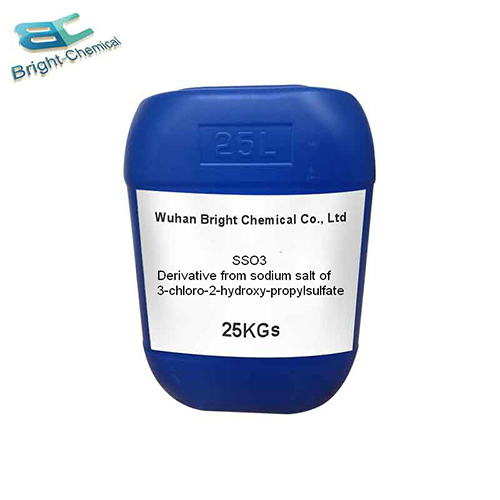
SSO3(Derivatives from 3- chloro-2-hydroxy-rpopylsulfonate, sodium salt)
- Serial number: D026
- Trade name: SSO3
- Chemical class Derivatives from 3- chloro-2-hydroxy-rpopylsulfonate, sodium salt
- Assay: 55%
- Appearance: colorless and transparent liquid
- related density@20 C 1.29-1.35
- refractive index@20 C 1.3975-1.4088
- PH value: 3.0-5.0
- Application: Impurities tolerance agent, improve covering power at low densities
Versatile Intermediate for Multiple IndustriesSSO3 Derivatives serve as a critical intermediate across several sectors such as pharmaceuticals, water treatment, and textile manufacturing. Its strong sulfonating ability ensures effective performance in surfactant production and ion-exchange resin synthesis, providing flexibility for industrial applications. The product's water solubility and stability further enhance its practical utility.
High Purity and Safety StandardsManufactured to contain less than 10 ppm heavy metals, less than 0.5% residual chloride, and less than 5 ppm of lead, this sodium salt maintains a high purity grade of 98%. It is non-poisonous, not classified as hazardous under GHS, and non-hazardous for transport, making it safe for handling and shipping under standard protocols.
Environmentally Responsible ChoiceThis chemical is readily biodegradable and features a low environmental impact profile. Proper storage ensures it remains stable and effective, while its shelf life of 24 months in original packaging supports extended use. Hygroscopic in nature, it must be stored in dry, cool, and ventilated areas to maintain product integrity.
FAQ's of SSO3 Derivatives from 3- Chloro-2-Hydroxy-Rpopylsulfonate Sodium Salt:
Q: How should SSO3 Derivatives from 3-Chloro-2-Hydroxypropylsulfonate Sodium Salt be stored?
A: Keep the container tightly closed in a dry, cool, and ventilated area away from incompatible substances. Its hygroscopic nature requires it to be stored properly to avoid moisture absorption and maintain stability.
Q: What are the common industrial applications for this product?
A: This sodium salt is used predominantly as an intermediate in pharmaceutical synthesis, surfactant manufacture, textile auxiliaries, ion-exchange resin synthesis, water treatment processes, and in agrochemicals.
Q: When does the product decompose, and can it be boiled?
A: SSO3 Derivatives decompose before reaching their boiling point and have a melting point range of 135-140C. It is advisable not to attempt boiling, as this will lead to decomposition.
Q: Where is the product sourced and who can supply it?
A: It is commercially available from manufacturers, exporters, distributors, suppliers, and traders-particularly from sources in China, shipped in 25 kg HDPE drums or customized packaging.
Q: What benefit does this product offer regarding environmental sustainability?
A: SSO3 Derivatives are readily biodegradable, minimizing environmental persistence and making them a responsible choice for industries prioritizing eco-friendly chemicals.
Q: How is SSO3 Derivatives utilized in chemical synthesis?
A: It acts as a sulfonating agent and an intermediate, donating sulfonate groups efficiently in the production of surfactants, ion-exchange resins, and other specialized chemicals.









 : +8613554014698


 Send Inquiry

 Send Inquiry
 Send Inquiry
 Send SMS
 Call Me Free
 English
 Spanish
 French
 German
 Italian
 Chinese (Simplified)
 Japanese
 Korean
 Arabic
 Portuguese