PABS Diethylamino-2-Propyne Sulfate About
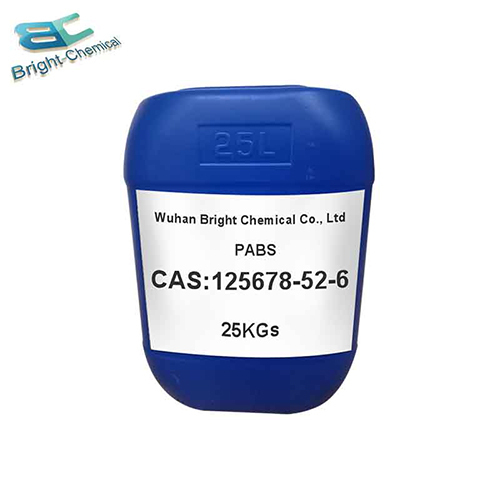
PABS(Diethylamino-2-propyne, sulfate)
- CAS No.: 125678-52-6
- Molecular formula: C8H15NO2
- related density@20C: 1.02-1.06
- Refractive index@20C: 1.4190-1.4320
- pH value: 4.5-5.8
- Water solubility: Insoluble in water
- Assay: 70%
- Appearance: Yellowish transparent liquid
- Application: Leveling agent, brightener
Efficient Brightening Additive for ElectroplatingPABS Diethylamino-2-Propyne Sulfate is recognized for its superior ability to improve the surface finish in electroplating applications. By promoting uniform grain structure and enhanced brightness, it helps manufacturers achieve consistent, high-quality results. Its total water solubility and low viscosity further simplify the preparation process, making it a preferred choice in a range of industrial plating baths.
Safe and Practical Handling and StorageThough classified as non-hazardous for transport, it is recommended to wear protective clothing and gloves while handling PABS. The product's stability from pH 5.0 to 9.0 means it retains its effectiveness under standard operating conditions. For extended shelf life, store it in tightly sealed containers, shielded from sunlight, in cool and dry environments away from incompatible substances.
FAQ's of PABS Diethylamino-2-Propyne Sulfate:
Q: How should PABS Diethylamino-2-Propyne Sulfate be used in plating baths?
A: PABS is generally introduced directly into the electroplating bath to enhance grain structure and improve surface brightness. Its excellent water solubility and low viscosity allow for easy blending. It is compatible with most common plating bath chemicals and maintains optimal performance within a pH range of 5.0 to 9.0.
Q: What is the main benefit of using PABS in electroplating applications?
A: The primary benefit of using PABS Diethylamino-2-Propyne Sulfate is its ability to produce finer, more uniform grain structures, resulting in brighter and more appealing plated surfaces. This can improve both product quality and visual appeal in surface treatment processes.
Q: What are the recommended handling precautions for PABS?
A: Although PABS is non-hazardous for transport and classified as non-poisonous, it is advisable to wear suitable protective gloves and clothing when handling it to prevent skin contact or splashes. Good industrial hygiene practices should always be followed.
Q: Where should PABS be stored for optimal stability and shelf life?
A: For optimal stability, PABS should be stored in tightly sealed HDPE drums or IBC tanks, in a cool, dry place away from sunlight and incompatible substances. Under these conditions, the product maintains a shelf life of up to 12 months from the date of manufacture.
Q: Is PABS environmentally friendly and how should it be disposed of?
A: PABS is not readily biodegradable and may pose risks if released into the environment. Therefore, care should be taken to avoid accidental discharge. Waste and residues should be disposed of in accordance with local environmental regulations, using approved disposal practices.
Q: What physical properties make PABS advantageous for industrial processes?
A: PABS is a clear, colorless to pale yellow liquid with low viscosity and total solubility in water. It has a mild amine-like odor, high purity (99%), and is stable under normal conditions, making it easy to handle and incorporate into existing industrial workflows.





 : +8613554014698


 Send Inquiry

 Send Inquiry
 Send Inquiry
 Send SMS
 Call Me Free
 English
 Spanish
 French
 German
 Italian
 Chinese (Simplified)
 Japanese
 Korean
 Arabic
 Portuguese