3-Chloro-2-Hydroxypropanesulfonic Acid Sodium Salt About
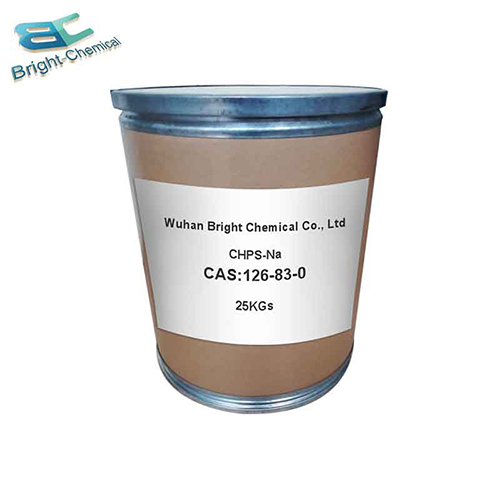
Organic salt / CAS:126-83-0, 3-Chloro-2-hydroxypropanesulfonic acid sodium salt
3-Chloro-2-hydroxypropane-1-sulfonic acid sodium salt
- Assay: 98.5% min
- Cas:126-83-0
- Trade name: CHPS-Na
- Other name:
- 1-Chloro-2-hydroxy-propane-3-sulfonicacid,sodium salt
- 1-Propanesulfonicacid,3-chloro-2-hydroxy-,mono-sodium salt
- 3-Chloro-2-hydroxy-1-propanesulfonicacid,sodium salt
- Molecular formula: C3H6O4ClSNa
- Molecular Weight: 196.6
- Linear Formula: NaSO3CH2CH(OH)CH2Cl
- EINECS: 204-807-0
- MDL Number: MFCD00013378
- Appearance: White crystalline powder
- Storage: Store at room temperature
CAS # 126-83-0, Sodium 3-chloro-2-hydroxypropanesulfonate, MF: C
3H
7ClO
4S
Application: As there are halogen atoms and Hydroxy with strong activity, and also sulfonate group with Hydrophilic In the molecular instruction of 3-Chloro-2-hydroxypropanesulfonic acid, sodium salt, CHPS-Na is an important functional monomer in the field of synthesizing polymer industry and it is also an organic chemical intermediate which is used in the preparation of Surfactant, modified starch and drilling fluid materials. CHPSNa is mainly used for the production of Biological buffer POPSO, MOPSO, & TAPSO.
Versatile Industrial Applications3-Chloro-2-Hydroxypropanesulfonic Acid Sodium Salt is widely used in the industrial sector, particularly for synthesizing essential polymer components and as an intermediate for surfactants and drilling fluid materials. Its adaptability makes it a valuable resource for manufacturers aiming to improve product efficacy and innovation.
Key Ingredient in Buffer SynthesisCHPS-Na is a foundational material for developing biological buffers, including POPSO, MOPSO, and TAPSO. Its specific chemical structure ensures the preparation of high-purity buffers that are critical for biochemical and industrial processes requiring controlled pH environments.
Safe Storage and HandlingWith a melting point of 185C and a density of 1.649 g/cm3, this compound remains stable under standard conditions. CHPS-Na's non-toxic, odorless, and crystalline form allows for straightforward storage at room temperature, ensuring consistent quality over its one-year shelf life.
FAQ's of 3-Chloro-2-Hydroxypropanesulfonic Acid Sodium Salt:
Q: How is 3-Chloro-2-Hydroxypropanesulfonic Acid Sodium Salt commonly used in industry?
A: It serves as a functional monomer for polymer synthesis and acts as an essential organic intermediate in the production of surfactants, modified starches, and specialized drilling fluid materials. It is also pivotal in preparing biological buffers such as POPSO, MOPSO, and TAPSO.
Q: What benefits does CHPS-Na offer as a chemical intermediate?
A: CHPS-Na provides high purity and consistent results, making it an effective intermediate for synthesizing various industrial products. Its role in the production of biological buffers and surfactants enhances the reliability and performance of end-use applications.
Q: When should CHPS-Na be stored, and what is its shelf life?
A: CHPS-Na should be stored at room temperature in appropriate chemical storage containers. Its shelf life is one year when maintained under recommended conditions, ensuring stability and quality during this period.
Q: Where is CHPS-Na primarily manufactured and supplied?
A: Most CHPS-Na available in the market is produced, distributed, exported, and supplied by manufacturers and chemical traders in China, serving a wide range of industrial users globally.
Q: What is the recommended process for using CHPS-Na in buffer preparation?
A: To synthesize biological buffers such as POPSO, MOPSO, or TAPSO, CHPS-Na is typically dissolved in a suitable solvent and reacted under controlled laboratory conditions, aiding in precise buffer solution formulation for biochemical processes.
Q: Is CHPS-Na safe to handle and use in industrial environments?
A: With its non-poisonous, odorless, and crystalline characteristics, CHPS-Na is considered safe for industrial handling when standard chemical safety protocols are observed. It poses minimal handling hazards compared to many industrial reagents.





 : +8613554014698


 Send Inquiry

 Send Inquiry
 Send Inquiry
 Send SMS
 Call Me Free
 English
 Spanish
 French
 German
 Italian
 Chinese (Simplified)
 Japanese
 Korean
 Arabic
 Portuguese