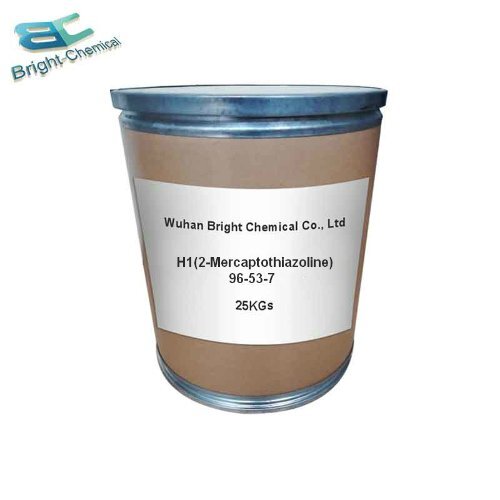
H1 (2-Mercapto Thiazoline) About
Specification
- Place of Origin : China
- Type : Copper plating agent
- Other Names : H1
- MF : C3H5NS2
- Brand Name : BRIGHT
- Model Number : H1
- Application : Copper plating agent
- Appearance : white crstal
Powerful Chelating Agent for Industrial ApplicationsH1 (2-Mercapto Thiazoline) is prized primarily for its strong chelation ability, which is pivotal in capturing and precipitating heavy metals during water treatment or industrial processes. With a high purity of over 99%, it ensures reliable results in various manufacturing and synthesis environments, including dye production and polymerization studies.
Safe Handling and Stable StorageTo ensure optimal stability and retain activity, H1 should be stored in a cool, dry place inside a tightly sealed container. It is stable under normal conditions, but moisture and high temperatures should be avoided. Proper handling minimizes risk of irritation and supports the shelf life of up to two years.
Versatile Uses Across IndustriesAs an industrial chemical, H1 serves multiple roles: from acting as a polymerization accelerator in chemical synthesis to aiding in heavy metal precipitation for water treatment. Its neutral pH and low water solubility allow it to function efficiently across different application domains, especially where precise metal ion capture and reactivity are essential.
FAQs of H1 (2-Mercapto Thiazoline):
Q: How should H1 (2-Mercapto Thiazoline) be properly stored and handled to ensure safety and stability?
A: H1 should be kept in a tightly sealed container placed in a cool, dry area, away from moisture and high temperatures. When handling, avoid ingestion, inhalation, and direct contact with skin or eyes by using appropriate personal protective equipment, as it may cause irritation.
Q: What are the main applications and benefits of using H1 in industrial processes?
A: This compound is mainly utilized as a chelating agent in heavy metal precipitation, a polymerization accelerator, and a component in dye manufacturing. Its primary benefits include strong metal-binding capacity, excellent reactivity, and overall stability under normal conditions.
Q: When is H1 typically used in water treatment and chemical synthesis applications?
A: H1 is introduced during phases where heavy metal ions need to be removed or captured from solutions, or where its reactivity can speed up chemical reactions, especially in polymerization. Its use is determined by the specific demands of each process, emphasizing its value during contamination control and efficient synthesis steps.
Q: Where can H1 be purchased and in what packaging is it supplied?
A: As a product of Chinese distributors, exporters, manufacturers, suppliers, and traders, H1 can be obtained in industrial markets globally. It is typically supplied in 25 kg fiber drums or bags, although custom packaging may be arranged upon request.
Q: What safety precautions should be considered due to its moderate toxicity?
A: Despite being non-poisonous, H1 is moderately toxic and classified as harmful if swallowed, causing irritation to skin and eyes. Therefore, avoid ingestion, inhalation, and prolonged exposure. It is not regulated under UN Dangerous Goods but should be handled with standard industrial precautions.
Q: How does the chemicals physical form and solubility affect its usage in different applications?
A: Being a white to off-white crystalline powder with slight solubility in water and better solubility in organic solvents, H1 can be dispersed or dissolved as needed for specific industrial processes, allowing it to function efficiently where targeted metal precipitation or reactivity is required.
Q: What are the advantages of choosing H1 over other metal-binding reagents?
A: H1 offers high purity, a neutral pH, robust stability, and efficient metal-chelating capabilities, ensuring reliable performance. Its non-poisonous but moderately toxic nature requires careful handling but poses less risk than more hazardous alternatives, making it a preferred choice for various industrial uses.







 : +8613554014698


 Send Inquiry

 Send Inquiry
 Send Inquiry
 Send SMS
 Call Me Free
 English
 Spanish
 French
 German
 Italian
 Chinese (Simplified)
 Japanese
 Korean
 Arabic
 Portuguese