Dibenzene sulfonimide About
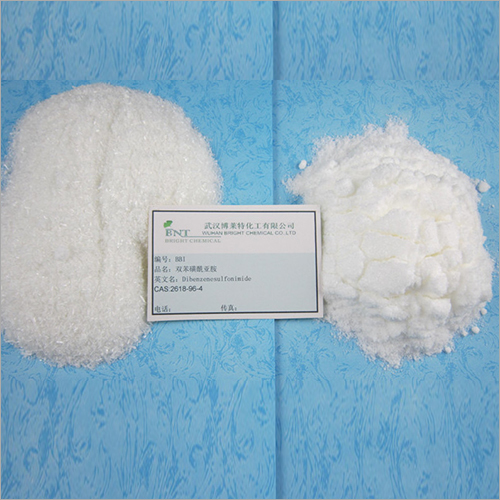
BBI Dibenzenesulfonimide
CAS No.: 2618-96-4
- EINECS: 220-051-4
- Molecular formula: C12H11O4NS2
- Linear Formula: (C6H5SO2)2NH
- MDL number: MFCD00025019
- Assay: 85%min or 98%min
- Appearance: White powder
- Melting point: 150-155oC
Application: Sulfonylimide compound, it has physical characteristic of sulfonyl imide soluble in alkaline solution. In electroplating, it is used as primary brightener instead of saccharin, It improves leveling, impurities tolerance, deposit brightness and reduction in overall usage of Saccharin.
It can be use as fine chemical intermediate, such as the raw material for synthesis of N-Fluorobenzenesulfonimide.
Advanced Electroplating BrightenerDibenzene sulfonimide is engineered for use in electroplating industries, serving as a superior alternative to saccharin. It acts as a primary brightener, offering improved leveling, greater tolerance to impurities, and enhanced deposit brightness. Its ability to reduce the need for saccharin optimizes the electroplating process, making coatings more consistent and cost-effective.
Multi-Functional Chemical IntermediateIn addition to its role in electroplating, dibenzene sulfonimide is a versatile intermediate in fine chemical synthesis, such as the production of N-Fluorobenzenesulfonimide. Its unique sulfonylimide structure allows it to participate in a variety of industrial reactions, broadening its utility in chemical manufacturing and specialty formulations.
Safe and Stable Industrial ProductWith its odorless, non-poisonous nature and 1-year shelf life, dibenzene sulfonimide offers peace of mind to manufacturers. This crystal-shaped, white powder poses minimal storage challenges, remaining stable at room temperature and allowing for straightforward inventory management and safe handling protocols.
FAQ's of Dibenzene sulfonimide:
Q: How is dibenzene sulfonimide typically used in industrial applications?
A: Dibenzene sulfonimide is primarily used as a brightener in electroplating baths, where it replaces saccharin to improve deposit brightness, leveling, and tolerance to impurities. It can also serve as a chemical intermediate for synthesizing specialty compounds like N-Fluorobenzenesulfonimide.
Q: What are the main benefits of using dibenzene sulfonimide over saccharin in electroplating?
A: The compound enhances leveling, boosts deposit brightness, and increases impurity tolerance compared to saccharin. Additionally, it reduces the overall usage of saccharin in the plating process, making it more efficient and cost-effective.
Q: Where should dibenzene sulfonimide be stored for optimal shelf life?
A: It should be kept at room temperature, in a dry, well-ventilated area, away from moisture and excessive heat. Proper storage ensures a shelf life of up to one year while retaining its physical and chemical characteristics.
Q: What is the process for dissolving dibenzene sulfonimide in solution?
A: Dibenzene sulfonimide is slightly soluble and should be dissolved in alkaline solutions to maximize its solubility. Gentle stirring and maintaining a suitable pH can help achieve a homogeneous mixture for industrial use.
Q: When is dibenzene sulfonimide commonly utilized during the electroplating process?
A: It is added during the bath preparation or adjustment phase, prior to electro-deposition, to ensure uniform distribution and optimized brightening effects on the metallic surface.
Q: What industrial grades and purities are available for dibenzene sulfonimide?
A: It is offered in industrial grades with purities of 85% and 99%, allowing manufacturers to select the appropriate specification for their particular process or synthesis requirement.
Q: Is dibenzene sulfonimide hazardous or poisonous when handled properly?
A: No, dibenzene sulfonimide is non-poisonous and considered safe when standard industrial handling procedures are followed. It is odorless and does not present significant toxic risks under typical usage conditions.





 : +8613554014698


 Send Inquiry

 Send Inquiry
 Send Inquiry
 Send SMS
 Call Me Free
 English
 Spanish
 French
 German
 Italian
 Chinese (Simplified)
 Japanese
 Korean
 Arabic
 Portuguese